
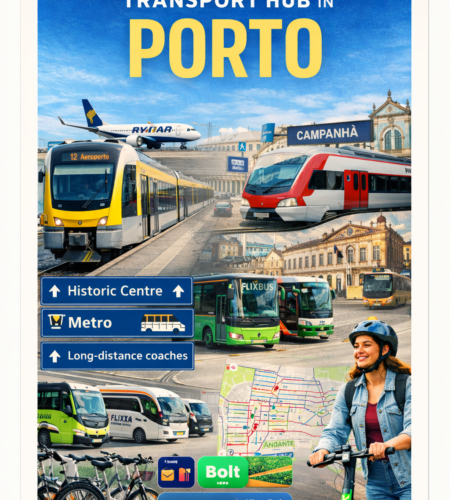
Porto is one of the easiest Portuguese cities to navigate if you understand the basic transport logic first. For most visitors, the key choices are simple: Metro Line E from the airport, São Bento for the historic centre, Campanhã for long-distance rail, and TIC Campanhã for intercity buses. This guide is written in a practical travel style, with clear stations, prices, addresses, and official website references for tourists.
Airport Connections
✈️ Porto Airport (OPO)
📍 Address: Aeroporto Francisco Sá Carneiro, Pedras Rubras, 4470-558 Porto
🌐 Website: portoairport.pt
🚇 Metro: Line E (Purple) connects the airport to the city and runs about every 20 or 30 minutes
⏱️ Travel time: around 30 minutes to the city centre
💶 Single public transport fare: airport trips typically use a Z4 fare, currently €2.30
🎫 Card cost: Andante Azul card costs €0.60
🎟️ Tourist pass: Andante Tour 1 costs €7.75 for 24 hours, and Andante Tour 3 costs €16.55 for 72 hours
For most tourists, the metro is the best airport transfer. It is straightforward, frequent, and cheaper than a taxi. The airport also has STCP bus connections, so public transport works well even if your accommodation is not directly on the metro line.
🚌 Airport Bus Options
🌐 Website: stcp.pt
🚌 Day lines: 601, 602, and 604
🌙 Night line: 3M
⏱️ Typical bus travel time: around 45 minutes to reach different parts of Porto
🕒 Frequency: lines 601 and 602 run about every 25 minutes, 604 about every 30 minutes, and 3M every 60 minutes overnight
If you arrive late, the 3M night bus is especially useful because it keeps the airport connected after normal daytime service slows down. During the day, the metro is usually faster than the bus for central Porto.
🚕 Taxi & Ride-Hailing from the Airport
🚕 Taxi / ride-hailing time to centre: about 20 minutes
💶 Average fare: around €20 to €25 to the city centre
📱 Ride apps commonly used: Uber, Bolt, and Free Now
🌐 Ride app website: bolt.eu
For travelers with heavy luggage or late-night arrivals, taxis and ride-hailing can be worth the extra cost. For solo visitors on a budget, the metro is usually the smarter value.
Rail & Train Stations
🚉 São Bento Railway Station
📍 Address: Praça de Almeida Garrett, 4000-069 Porto
🌐 Website: cp.pt
🏛️ Why it matters: São Bento is the famous central station in Porto’s historic core
🧭 Best for: visitors staying in the old town, Ribeira, Aliados, or nearby central areas
São Bento is the most scenic station in Porto and the easiest one to recognize for first-time visitors. It sits right in the centre and works especially well if your hotel is near the main historic districts. That “best for central sightseeing” recommendation is a practical travel inference based on its location.
🚄 Campanhã Station
📍 Address: Largo da Estação de Campanhã, 4300-173 Porto
🌐 Website: cp.pt
🚆 Services: International, Alfa Pendular, Intercity, Interregional, Regional, and Urban trains
🚇 Connections: metro, bus, and taxi
🧳 Useful extras: ticket offices, vending machines, waiting room, lockers, toilets, cafeteria, parking, and car rental service
Campanhã is the main heavy-transport rail hub in Porto. If you are heading to Lisbon, Braga, Guimarães, Aveiro, or beyond, this is the station you usually need. It is the more practical station for longer national and international rail travel.
🎫 Train Ticket Basics
🌐 Website: cp.pt
📱 Where to buy: CP website, CP app, ticket offices, and ticket vending machines
🏢 Extra help: the Porto Mobility Centre at Porto São Bento Station provides information and ticket sales
For most travelers, the easiest rule is simple: use São Bento for the historic centre and Campanhã for major rail connections.
Central Bus Terminal
🚌 TIC – Terminal Intermodal de Campanhã
📍 Address: Rua de Bonjóia, 4300-084 Porto
🌐 Website: terminais.porto.pt
🚇 Connections: metro, train, and bus
🚉 Metro access: lines A, B, C, E, and F connect through Campanhã
🧳 Facilities: ticket office, information point, luggage storage, waiting room, parking, and bike parking
For Porto today, TIC Campanhã is the main intercity bus terminal visitors should know. It is directly linked to the transport cluster around Campanhã, which makes transfers between coach, metro, and train much easier than older scattered stop setups.
🚌 Long-Distance Coach Operators
🌐 FlixBus: flixbus.com
🌐 Rede Expressos: rede-expressos.pt
📍 Common Porto stop: Porto (TIC – Campanhã)
A useful Porto rule is to double-check the stop shown on your ticket, but for most long-distance coach trips the key place is TIC Campanhã.
Taxi & Ride Options
🌐 Airport / city arrival info: visitporto.travel
🌐 Ride app info: bolt.eu
🚕 Average airport-to-centre ride: about 20 minutes
💶 Typical fare: around €20–€25
📱 Common options: taxi, Uber, Bolt, and Free Now
In Porto, taxis and ride-hailing make the most sense when you want a direct hotel drop, you are arriving late, or you are moving with large bags. For normal daytime sightseeing, metro plus walking is usually more efficient.
Rentals & Shared Mobility
🛴 Bolt Scooters and E-Bikes
🌐 Website: bolt.eu
📱 Available in Porto: rides, scooters, bikes, and more
✅ Best for: short city hops, riverfront movement, and flexible last-mile travel
🚗 Bolt Drive
🌐 Website: bolt.eu
🚘 Service: short-term rental cars in the city
✅ Best for: quick car access without a classic full-rental desk process
🚘 Airport Car Rental
🌐 Website: portoairport.pt
🚗 Good for: Douro Valley day trips, Braga, Guimarães, beaches, and regional travel outside the urban core
For most city breaks, you do not need a car inside central Porto. But for day trips around northern Portugal, airport car rental can make a lot of sense. That recommendation is a practical inference based on Porto’s strong central public transport and the airport’s rental options.
Practical Tips for Visitors
🌐 Public transport website: andante.pt
🌐 Metro website: metrodoporto.pt
🎫 One ticket system: Andante works across bus, metro, and train in the Porto Metropolitan Area
✅ Validation rule: validate when you start a trip and whenever you change line or mode
💶 Airport contactless fare: €2.30 per journey on the eligible contactless system
💶 Daily cap on eligible contactless use: €7.75
📍 Useful central stations for visitors: Trindade, Aliados, São Bento, Bolhão, and Campanhã are among the key practical stations for tourists
The most important thing to understand in Porto is that Andante is the transport system glue. Once you know that one ticket can cover metro, bus, and some train travel in the metro area, the city becomes much easier to use.
FAQ
What is the best way to get from Porto Airport to the city centre?
For most visitors, the Metro Line E is the best option. It runs roughly every 20 to 30 minutes and takes about 30 minutes to reach the city centre.
How much does the airport metro cost in Porto?
A typical airport trip uses the Z4 fare, currently €2.30, and the reusable Andante Azul card costs €0.60.
Which Porto station is best for tourists?
Usually São Bento is best for the historic centre, while Campanhã is better for major rail connections across Portugal and beyond.
Where do long-distance buses leave from in Porto?
Most travelers should use TIC – Terminal Intermodal de Campanhã, Porto’s main intercity bus terminal linked to Campanhã rail and metro connections.
Are taxis expensive in Porto?
They are not extreme by Western European standards, but they are still far more expensive than metro or bus. From the airport to the centre, the average ride is around €20–€25.
Conclusion
The easiest way to think about Porto transport is this: Metro Line E from the airport, São Bento for the old centre, Campanhã for rail, TIC Campanhã for coaches, and Andante for everyday public transport logic. Once you follow that system, Porto is very manageable even on a short first visit.
Comments